
Executive Summary#
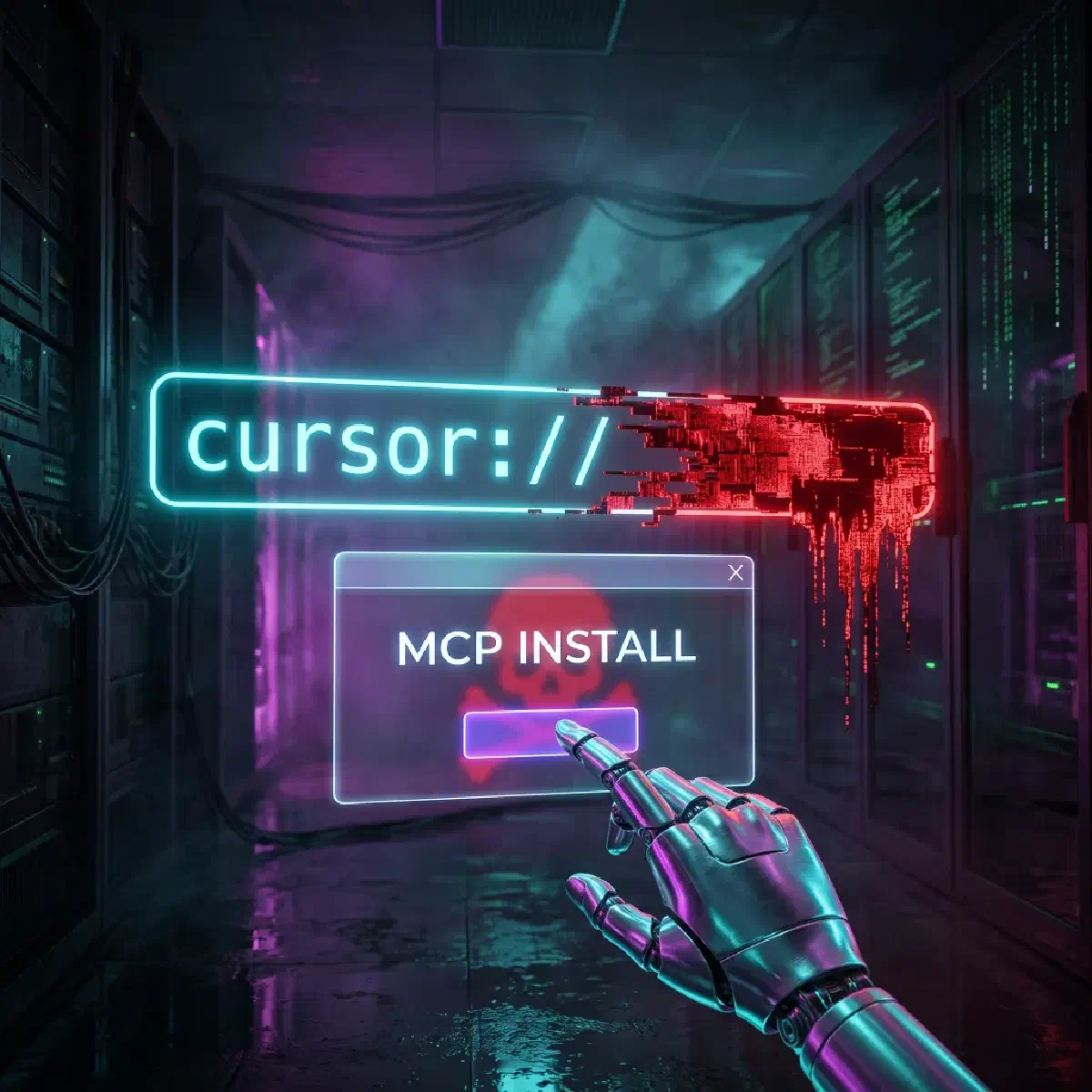
Continuing the TrustFall and SymJack line of work on agentic coding tools, I looked at how these agents handle custom URL schemes. The result is DeepJack: a critical flaw in Cursor (through v3.9.8) where a single malicious cursor:// deeplink — delivered as an innocent-looking “please review this PR” message over email or Slack — achieves one-click, unsandboxed Remote Code Execution.
The trick is the same deception seen in SymJack: the approval dialog lies. It shows the user a harmless command while a hidden payload rides along, invisible in the prompt but fully executed once approved.
Vulnerability Risk Assessment: CRITICAL
- Vulnerability Name: DeepJack
- Affected Tools: Cursor (≤ v3.9.8); the deeplink/argument-injection pattern has broader implications for most mainstream coding agents
- Vulnerability Type: Argument injection via custom URL-scheme handler leading to one-click RCE
- Attack Vector: A crafted
cursor://deeplink phished via email, Slack, or any channel that renders links - Impact: Unsandboxed execution with the developer’s privileges — a direct path to SSH keys, cloud credentials, source code, and CI/production
How the Vulnerability Works#
- Crafted Deeplink: The attacker builds a
cursor://URI that carries an encodedmcp/installcommand, nested inside apr-reviewparameter using double URL-encoding to slip past validation. - The Phish: The victim receives a message that looks like a routine code-review request and clicks the link.
- The Lying Dialog: Cursor opens its MCP install dialog. It renders the arguments in a single-line field showing a benign command (e.g.
calc), while the real payload is hidden after tab characters, out of view. - One-Click Execution: The user approves what looks harmless. The full command — hidden portion included — runs unsandboxed with the victim’s privileges, registering a malicious MCP server and executing the attacker’s code.
As with TrustFall and SymJack, the danger multiplies in automated pipelines: any surface that resolves deeplinks or auto-approves MCP installs turns a single click into instant credential and secret exposure.
Full Research and Details#
For the complete technical breakdown, including proof-of-concept and vendor response, read the original publication:
👉 DeepJack: Cursor deeplink vulnerability — 1-click MCP server RCE (Published on Adversa AI)